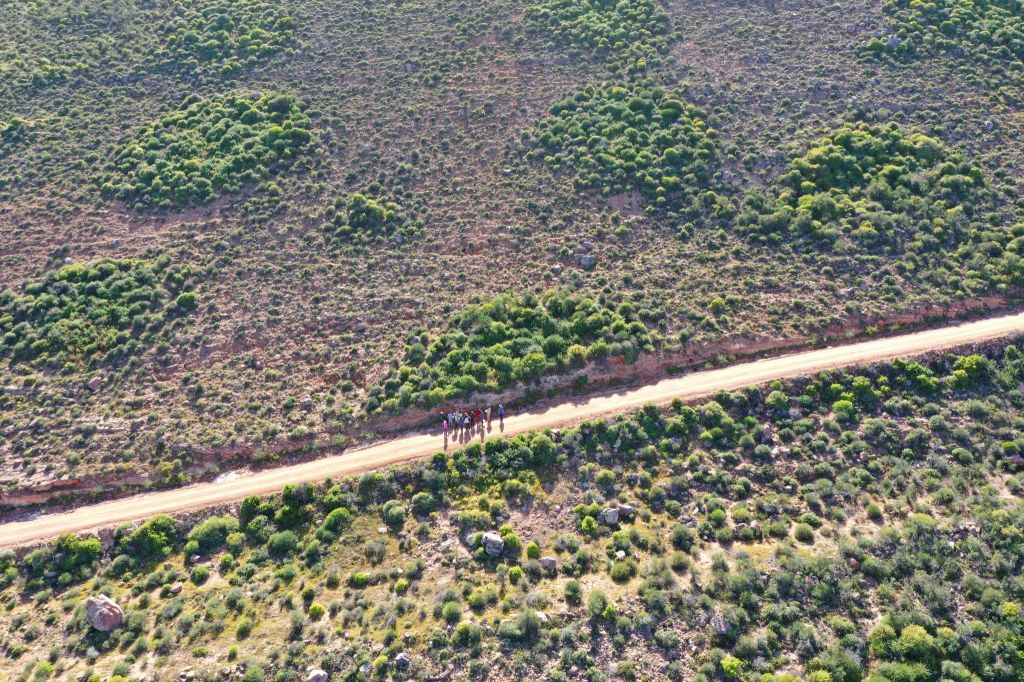
Heuweltjies, ancient earthen mounds in South Africa’s semi-arid Succulent Karoo biome, serve as critical hotspots for biodiversity. Their elevated soil nutrients and unique microhabitats allow them to act as refuges for plants and arthropods during drought and as ancient records of past climate. In dry areas, long-lasting carbon often forms as soil inorganic carbon, such as calcium carbonate (CaCO₃). In South Africa’s Greater Cape Floristic Region, termite-built mounds (heuweltjies) may form CaCO₃ by microbially-induced carbonate precipitation pathways. In this way, heuweltjie soil can help capture carbon from the atmosphere, reducing climate-warming CO₂. However, these processes are not well understood and human land use and the effects of global climate change threaten to alter these vital ecosystems.

My PhD project
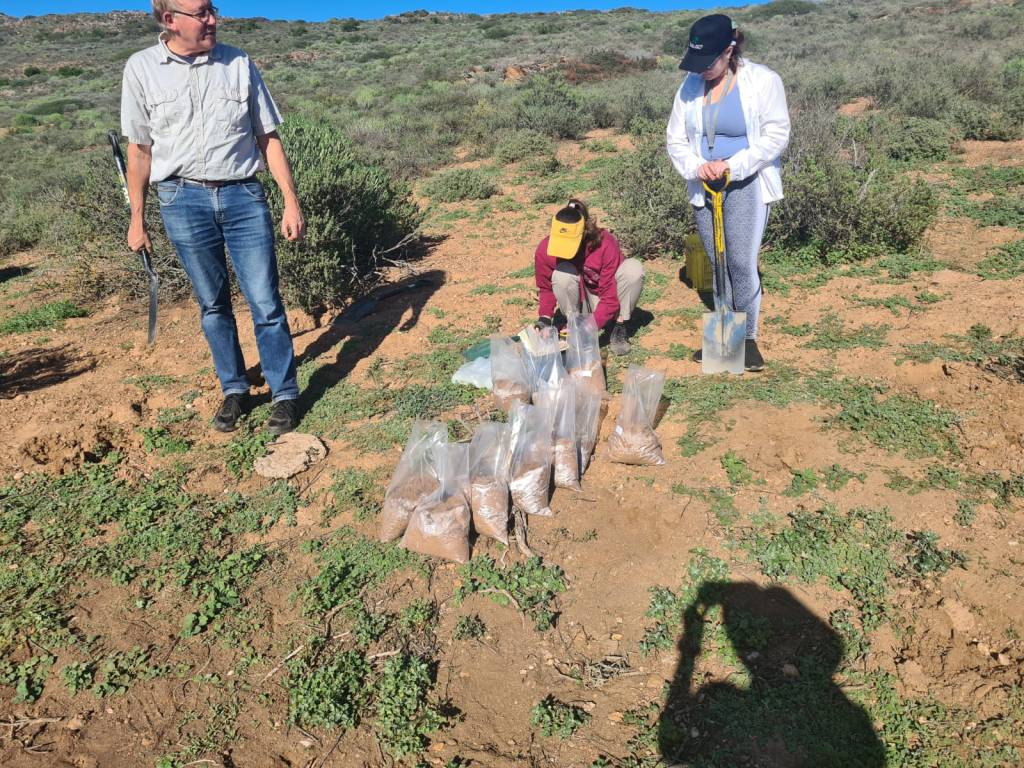
My study created new tools to detect OCP activity and track carbon in heuweltjie soils. Methods included measuring oxalate with infrared spectroscopy and testing soil gas in incubation experiments. Samples came from dry (Koringberg) and wetter (Stellenbosch) sites, as well as farmed and natural mounds, to test how climate and land use affect carbon storage. For this study, I conducted field work in South Africa and laboratory analyses at Stellenbosch University, developed soil incubation respiratory gas collection techniques during a research visit at Kent State University in the United States, and measured radiocarbon signatures of soil samples and soil-respired gas at the Max Planck Institute for Biogeochemistry in Germany. Results showed that heuweltjies store large amounts of carbon—up to half of the soil carbon in some areas. Natural mounds held more carbon in their topsoils than farmed ones, thanks to richer organic matter from native plants. Deeper, farmed mounds stored carbon further down. Evidence of OCP was found, with soils treated with termite waste (“frass”) capturing more carbon than those treated with pure calcium oxalate. Overall, this study developed a toolkit to better track how termite mounds store carbon, helping guide land-use choices that support climate benefits.
Work packages
In the first work package, the spatial distribution of soil carbon (C) in termite mounds from contrasting climates was investigated. A mound in the wetter Stellenbosch region showed higher surface soil organic carbon (SOC) than those in the drier Koringberg area, reflecting greater vegetation inputs under higher rainfall. In Koringberg, soil inorganic carbon (SIC) accumulated beneath SOC-enriched layers, consistent with biogenic carbonate formation. Across the agricultural landscape, heuweltjies were estimated to store about half of the total soil C, largely within subsoils. Cultivated mounds contributed proportionally less SOC than undisturbed ones, highlighting the impact of vegetation removal on termite diets and frass quality.
The second work package focused on developing a mid-infrared (MIR) spectroscopic method to quantify oxalate salts in clay mixtures, vegetation, and termite frass, as well as oxalic acid in solutions and extracts. The method successfully distinguished between soluble and sparingly soluble oxalates, accurately predicting calcium oxalate (CaOx) content in frass and mineral samples. While MIR offered a rapid, cost-effective alternative to traditional wet chemistry techniques, it was not suitable for direct measurement of CaOx in dry plant tissues. Nonetheless, the method provides valuable applications for microbiological studies of oxalotrophy and for tracing oxalate contributions in termite-influenced soils.
The MIR method was applied to quantify oxalates in frass at different decomposition stages, revealing oxalate oxidation processes. Oxalate concentrations varied with rainfall region and biome, with CaOx generally lower in mesic compared to semi-arid areas. This likely reflected soil moisture or microbial differences. Vegetation and frass from the Succulent Karoo contained more soluble oxalates than those from Fynbos, suggesting a drought-induced response. Frass from termite mounds also showed elevated soluble oxalates compared to surrounding soils, possibly due to plant responses to herbivory. These patterns identified environmental drivers of oxalate distribution and potential hotspots for the oxalate-carbonate pathway (OCP).
The third work package tested a multi-proxy incubation approach to evaluate the OCP in cultivated and uncultivated heuweltjie soils. Treatments with CaOx and frass indicated OCP activity, shown by increased pH and calcite saturation. Frass stimulated higher microbial activity and greater soil C sequestration, though cultivation appeared to reduce oxalotrophy. Interestingly, cultivated soils may still sequester C through CO2 fixation. Soil pore gas measurements proved effective for assessing OCP in CaOx-amended soils but less so in frass treatments where redox processes complicated signals. This chapter expanded the OCP toolkit and provided experimental evidence that termite-affected soils can contribute meaningfully to C sequestration in landscapes.
Biodiversity on a changing planet (BoCP)
My study formed part of an overarching project jointly funded by the National Research Foundation (South Africa) and National Science Foundation (United States). Our inter-disciplinary team comprised of experts in soil science, geochemistry, microbiology, genomics and ecology. The collaborators included professors and students from Stellenbosch University (Prof Catherine E. Clarke, Prof Michele L. Francis, Prof Alf Botha, Dr Teneille Nel, Darya Babenko, Hamond Motsi), Kent State University (Prof Timothy Gallagher, Alyssa Reinhardt), University of Texas at Austin (Prof Daniel O. Breecker, Morgan Mellum), Nelson Mandela University (Dr Alastair Potts), University of the Western Cape (Prof Marla Trindade, Dr Lonnie Van Zyl, Ryan Bird) and the University of Pretoria (Prof Don Cowan, Dr Pedro Lebre). We also worked closely with botanists such as Dr Ute Schmiedel, Dr Joe R. McAuliffe and Prof M Timm Hoffman.
Field guidebook
An open-access interpretive field guidebook to the heuweltjie-covered landscapes of western South Africa is now available. Co-authored by an international team of scientists, the guide offers road logs, field stops, and in-depth chapters on the ecology, geology, and history of these unique “mound landscapes.” Click here to download.
Social media and press


