
Brady Soil, Nebraska
Paleosols
Paleosols provide unique opportunities for asking broader questions relevant for modern and future projections of feedbacks among soil processes, carbon, landscape disturbance and climate. Our research directly addresses soil carbon response to two realistic climate change impacts in the central Great Plains and other loess-covered regions worldwide: expanded irrigation and extreme rainfall events that can reconnect buried soil carbon to the atmosphere.
The team
This research involved contributions from an interdiscplinary team representing the fields of soil science, biogeochemistry, geography, ecology, geology, and environmental chemistry. Researchers included Prof Asmeret Asefaw Berhe (University of California, Merced), Prof Karis McFarlane (Lawrence Livermore National Laboratory), Prof Erika Marin-Spiotta (University of Wisconsin–Madison), Prof Marie-Anne de Graaff (Boise State University), Prof Teamrat A. Ghezzehei (University of California, Merced), Prof Joseph A. Mason (University of Wisconsin–Madison), Dr Laura M. Phillips (University of Wisconsin–Madison), Dr Manisha Dolui (University of California, Merced), Dr Teneille Nel (University of California, Merced), Dr Stephanie Chacon (University of California, Merced), Prof Malak Tfaily (University of Arizona), Kimber Moreland (Lawrence Livermore National Laboratory), Abbygail R. McMurtry (Boise State University)
Buried soil carbon dynamics
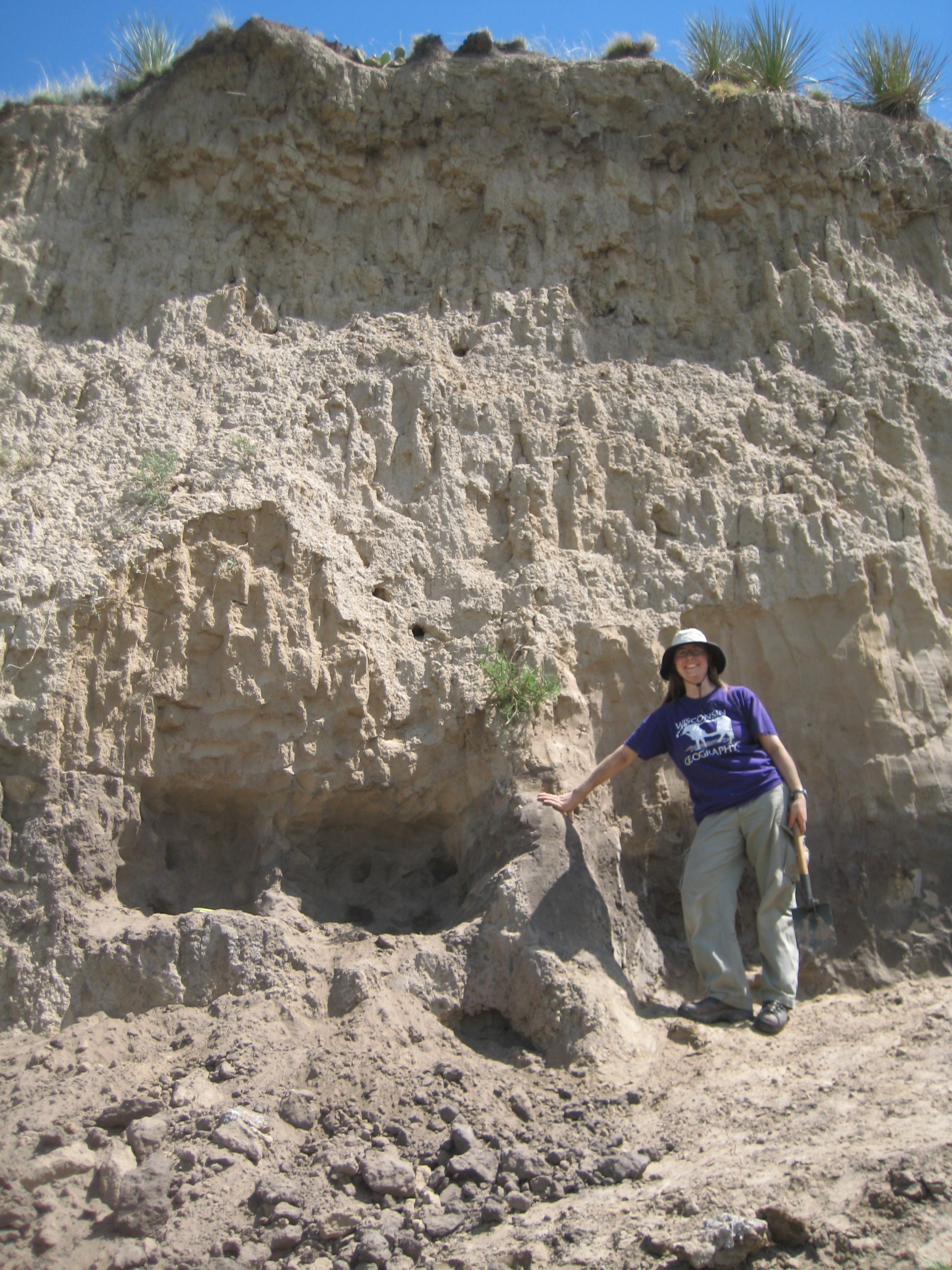
This project investigated how carbon stored in ancient buried soils responded to environmental change and disturbance. Buried soils, also known as paleosols, are former land surfaces that became covered by sediments such as wind-blown dust (loess), volcanic ash, or flood deposits—sometimes repeatedly—over thousands of years. These buried horizons are widespread across landscapes worldwide and can hold significant amounts of organic carbon, much of it thousands of years old. Because they are disconnected from surface conditions, buried soils can preserve carbon far longer than typical soils, yet their stability may be threatened when erosion, climate change, or land-use activities expose them again.
Our research focused on the Brady paleosol in the U.S. Great Plains, which formed about 13,000–10,000 years ago and was buried by thick loess deposits. Using advanced chemical, isotopic, and microbial techniques, we examined how the amount, composition, and age of soil organic matter (SOM) varied across burial depths and stages of exposure. Laboratory experiments tested how moisture, nutrient inputs, and microbial communities influenced decomposition, revealing conditions under which ancient carbon might be mobilized.
Findings improved understanding of the mechanisms that allowed SOM to persist for millennia and assessed how environmental change could turn these ancient carbon stores into modern sources of greenhouse gases, refining predictions of soil–climate feedbacks and carbon cycle dynamics.
My work at University of California, Merced
During my postdoctoral appointment, I analysed datasets produced by the PhD work of Manisha Dolui under the mentorship of Prof. Asmeret Asefaw Berhe. My task was to investigate the impacts of erosional exposure and moisture variability on carbon stability in buried soil. In my first study, I investigated how ancient buried soils, or paleosols, function as long-term carbon reservoirs. These soils, formed thousands of years ago and subsequently covered by layers of sediment, are isolated from surface processes that typically drive organic matter decomposition. I examined the molecular and geochemical characteristics that enable paleosols to retain carbon over millennial timescales. The results demonstrated that mineral associations, particularly with clay particles and polyvalent cations such as calcium and magnesium, play a critical role in stabilizing organic carbon. These minerals form strong bonds with organic matter, effectively protecting it from microbial breakdown and other decay processes. This paper provided foundational evidence for the concept of paleosols as natural carbon “time capsules,” highlighting their importance in the global carbon cycle. Building on this understanding, my second paper explored what happens when buried soils are exposed to surface conditions through erosion or landscape disturbance. I investigated how changes in moisture regimes and temperature fluctuations influence the stability of legacy carbon that has been protected for millennia. Experimental results revealed that re-exposed paleosols experience significantly higher decomposition rates than modern soils, particularly under cycles of wetting, drying, and thermal variation. This work demonstrated that ancient carbon is not inherently inert; instead, its stability depends strongly on being maintained in a buried and protected state. Once this protective barrier is removed, the carbon is rapidly mobilized, increasing the potential for release to the atmosphere as CO₂. My third study synthesized these findings to assess their broader implications for soil carbon dynamics and climate feedbacks. I examined how paleosol exposure, driven by natural erosion or human activities, could contribute to carbon emissions under changing environmental conditions. The analysis indicated that previously unaccounted-for carbon losses from exposed paleosols may represent a significant source of greenhouse gas emissions, particularly in regions with widespread buried soils. This work underscores the importance of protecting vulnerable soil landscapes and integrating paleosol carbon dynamics into global carbon cycle models and climate mitigation strategies.

 Teneille Nel - Researcher